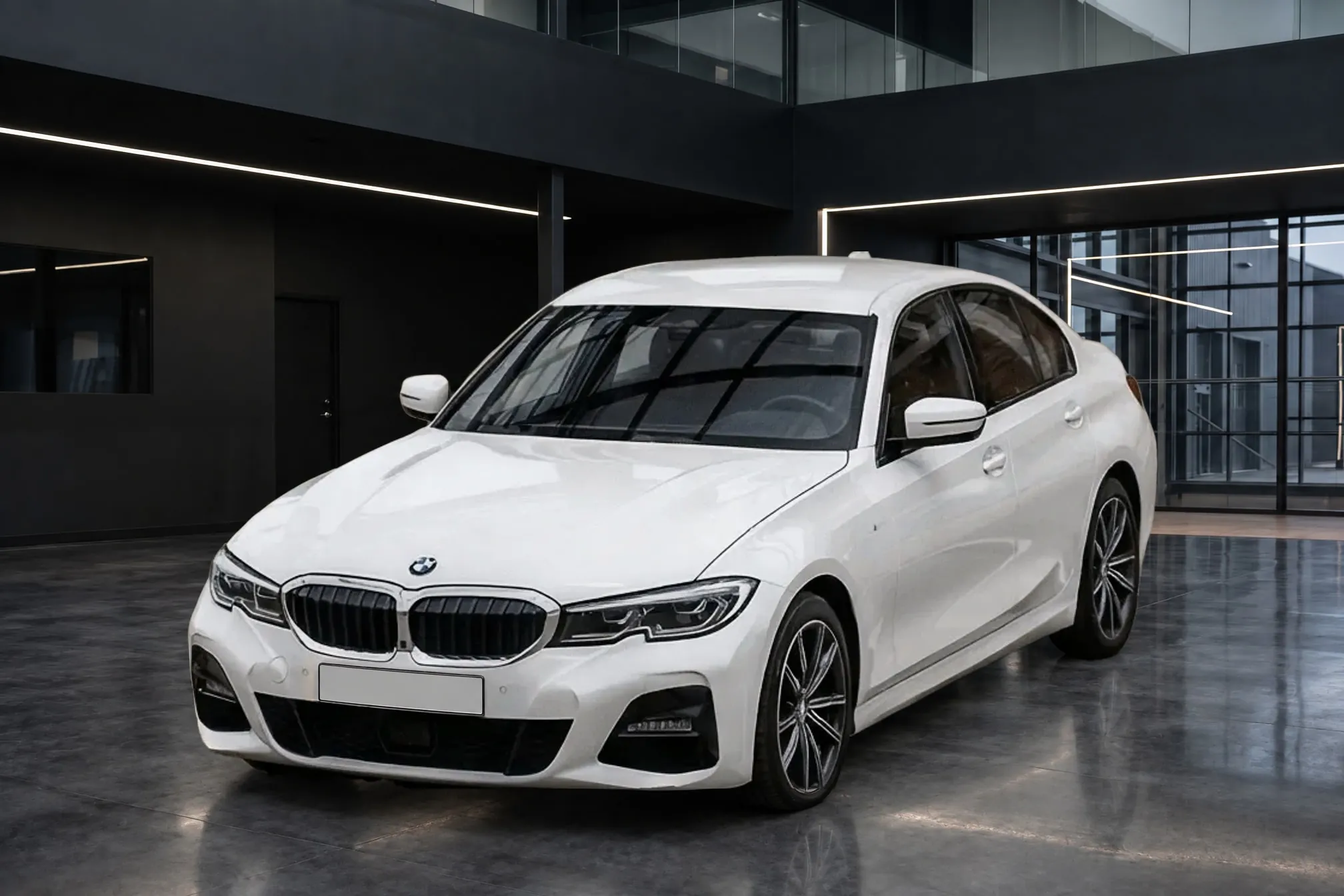
How to write a used car listing description
What a used car description should say that the listing fields and photos can't, how to describe condition and damage, which words carry legal weight, an example, and how to write a whole lot's descriptions with AI without a robotic tone or invented features.
A good used car description tells the buyer what the listing's fields and photos can't. Keep it short and put the most useful line first, because on a phone the opening lines are what shows before the rest is tapped open. It covers five things:
- a lead line on what sets this car apart from others like it
- the equipment buyers of this model ask about
- its condition, with every flaw you know of named plainly
- its history, worded as the history report words it
- the terms it is sold on, matching the Buyers Guide
Write only what you can back up with a document or a photo, because words like "certified", "no accidents" and "warranty" carry legal weight. To write descriptions for a whole lot with AI, give the model each car's own facts, a house style with a few varied examples and a rule to add nothing else. Then have a person check each one against the car before it goes live.
We make Clearcoat, AI car photography for dealerships, so a section near the end covers how the description and the photos should agree, and where to say that a Showroom photo was made with AI. Everything else applies to any listing, on any site.
Why the description matters on a used car listing
A used car description is for what the listing's fields can't say. On Cars.com, Autotrader, CarGurus and Facebook Marketplace, the year, make, model, trim, mileage and price already sit in their own fields above the text, filled from your inventory feed. Repeating them in the first line of the description spends the only line many shoppers read.
What buyers can't get from the fields is the car's story: who owned it, how it was kept, what you fixed, and what is wrong with it. That is also what moves the price. Economist Gregory Lewis studied 82,538 eBay Motors auctions. Listings whose text mentioned a "receipt" sold for about 13% more than comparable cars, and listings that mentioned "broken" for about 14% less (Lewis, 2009 working paper, published in the American Economic Review in 2011). Specific, checkable facts carried the weight. The study measures auctions on one site, and its figures are associations, not proof that a word causes a price, but it is the most careful evidence we found on car listing text.
Dealers describe the gap from the other side. "Most are blank/no description. Beyond that, many are cut and paste same gibberish over and over," one dealer wrote in 2023 (DealerRefresh). Another put the reading habit plainly in 2015: "No one reads, they scan" (DealerRefresh). So a description earns its place by answering the questions a shopper would otherwise call about, in lines that can be scanned. If buyers keep calling to ask whether a car has a feature, whether it has been in an accident or whether it comes with a warranty, the description isn't answering them.
What to include in a used car listing description
Most of this list comes from the dealer guides that rank for the question (ACV, Cars Commerce DealerClub, CLASSIC.COM) and from what state rules require a used car ad to disclose. In order:
- A lead line that says what sets this car apart. One sentence: the trim or package worth naming, the ownership the report shows, the recent work. "One owner per the CARFAX report, new tires and brakes" beats "Clean SUV, must see".
- The equipment buyers of this model ask about. Pick the four to six features that matter for this car and skip the standard equipment every one of them has. One dealer on DealerRefresh suggests "a master list of features ranked by customer desirability," checked against each car's actual equipment (DealerRefresh).
- Condition, flaws included. Name each flaw you know of, in plain words, and say that it is in the photos. The next section covers wording.
- History, as the report words it. Number of owners, reported accidents, title status, and prior use where it applies. If you checked for open recalls by VIN on NHTSA's recall lookup, say when you checked and whether any were repaired. New York requires an ad for a specific used car to disclose prior use as a police, fire, taxi, driver education or rental car, and a lemon law buyback, when the dealer knows or should have known of it (New York Attorney General). Washington requires a rebuilt vehicle to be identified as rebuilt (WAC 308-66-152), and eBay asks that "any branded title or history (such as flood or salvage) is disclosed in your listing description" (eBay).
- Service and reconditioning. What you replaced or repaired, and the records you have. A receipt or a service record is what turns "well maintained" into a fact.
- The terms. Whether the car comes with a warranty or is sold as is, in the same words as the Buyers Guide on the car, plus what comes with it: keys, manuals, a remaining factory warranty.
- A note on how the photos were made, if they were edited. If a background was replaced, one line such as "Showroom setting created with AI from our own photo of this vehicle." The reasons are in Are AI-edited car photos allowed?
Leave out what the fields already show, the price included, and anything a buyer can't check.
How to describe a used car's condition and damage
Describe condition by naming what is there, not by grading it. "Excellent condition" tells a buyer nothing they can check, and some states treat it as a claim you must be able to support. Florida makes it actionable for a dealer to "represent the quality of care, regularity of servicing, or general condition of a vehicle unless known by the dealer to be true and supportable by material fact" (Fla. Stat. § 501.976).
Name each flaw with where it is and how big it is:
| Vague | Specific |
|---|---|
| Minor cosmetic wear | A 2-inch scratch on the rear bumper, below the tailgate |
| Wheels in good shape | Light curb rash on the front right wheel |
| Interior shows some use | Wear on the driver's seat bolster; no tears or stains |
| Runs great | Oil change and multi-point inspection at intake; report available |
The specific version is safer, and the buyer can check it. "Small imperfections won't always turn off a buyer. Surprises later will," as PrivateAuto puts it (PrivateAuto). It also has to match the photos. Cars Commerce tells sellers on its DealerClub marketplace that "your vehicle description should always match the Condition Report and photos," because "any inconsistencies can lead to disputes or impact seller ratings" (Cars Commerce). Every flaw the text names should have a close-up among the photos, and every flaw a close-up shows should be in the text.
When you don't know something, say so. "Odometer reading believed accurate" or "service history unknown before 2023" is better than silence on a question the buyer will ask anyway.
Words to avoid in a used car ad unless you can prove them
Some words in a description are claims a regulator or a listing site holds you to. Each one below is fine when a document backs it, and a risk when it is boilerplate pasted onto every car.
| Words | What has to back them | Source |
|---|---|---|
| "Certified" | In New York, a manufacturer's inspection program "backed by the manufacturer's warranty" that this car passed. In Oregon, a disclosed program with a real benefit. In California, a car that meets the certified rules, which exclude lemon buybacks, branded titles, frame damage and "as is" sales | NY AG, OAR 137-020-0050, California Vehicle Code 11713.18 |
| "One owner", "no accidents" | A history report, worded as the report words it: "No accidents reported to CARFAX". CARFAX itself says it "does not have the complete history of every vehicle." Florida requires an inspection before a dealer says a car has no structural damage | CARFAX, Fla. Stat. § 501.976 |
| "Inspected", "multi-point inspection" | An inspection of this car you can show. The FTC's 2024 case against the online dealer Vroom cited its claim of "184 points of inspection that were checked on every car" | FTC |
| "Warranty", "warrantied" | The Buyers Guide on the car. The FTC's Used Car Rule bars written statements that "alter or contradict" it, so a car whose Buyers Guide says "As Is" can't be described as warrantied | 16 CFR 455.4 |
| "$299 a month", "$0 down" | The full credit terms. Stating a down payment, a payment amount or a number of payments triggers the APR and other disclosures under Regulation Z | 12 CFR 1026.24 |
| "Like new", "mint", "almost new" | A car that is. New York requires a repurchased rental described as "almost new" to disclose its rental use | NY AG |
Price belongs in the price field, as the total. Cars.com asks that the listed price reflect the vehicle's true selling price, mandatory fees included, and in March 2026 the FTC warned 97 dealership groups that advertised prices "must be the total price" with all mandatory fees included (FTC). The FTC's CARS Rule, which would have added specific dealer advertising rules, was vacated by the Fifth Circuit in January 2025 (NADA v. FTC), but the FTC Act, the Used Car Rule and state law still apply. State rules differ and this is not legal advice; check your own state's dealer advertising rules.
How long a used car description should be
No study we found measures the ideal length of a car description. ACV suggests "a maximum of three paragraphs" (ACV). Our recommendation is a lead line, four to six bullets, a condition line, a history line and the terms: about 100 to 200 words. That covers everything above and reads in a few seconds on a phone. The sites' limits are far higher, so length is your choice, not theirs. Facebook Marketplace's vehicle feed limits the description to 5,000 characters and supports no HTML (Meta), and Google's vehicle ads feed takes the description as free text with no limit stated (Google).
Write for the first line, because that is the part that shows in a preview. Skip capitals for emphasis, which Cox Automotive and Autotrader both advise against.
Used car description example
Here is the same car described two ways. The car is illustrative, not a real listing.
The usual version:
WOW!!! Check out this BEAUTIFUL CR-V!! Loaded, like new, runs and drives perfect. Clean Carfax. Don't miss out, this one won't last. Call today!
The version that answers the buyer's questions:
One owner per the CARFAX report, with dealer service records from new and new tires at 46,000 miles.
- Leather, heated front seats and a power tailgate
- Moonroof
- Apple CarPlay and Android Auto
- All-wheel drive
Condition: a 2-inch scratch on the rear bumper below the tailgate and light curb rash on the front right wheel, both in the photos. Interior: no tears, stains or odors; light wear on the driver's seat bolster.
History: no accidents reported to CARFAX. Clean title. Previous owner traded it in here.
Reconditioning: four new tires, front brake pads and an oil change.
Terms: sold with our 90-day, 3,000-mile limited warranty; see the Buyers Guide for coverage. Two keys and the owner's manual included.
Showroom setting in the exterior photos created with AI from our own photos of this car. Interior and detail photos as taken.
The second version is under 150 words. Every line in it is something the buyer could check, and none repeats the year, mileage or price the listing already shows.
How to write used car descriptions with AI
AI can write a whole lot's descriptions in the time it takes to write one, and inventory tools such as CDK's description writer now build it in. The two things that go wrong are the voice, when every car on the lot reads alike, and the facts, when the model fills a gap with equipment the car doesn't have. Both come from what the model is given, so both are fixed the same way: give it each car's own facts, a house style, and a person who checks the result.
Give the AI each car's own facts
A model given only the year, make and model writes from what it knows about that model in general, and that is where wrong trims and invented options come from. Give it:
- Build data or the window sticker. A VIN encodes the make, line, series, body type, engine and restraint systems, not the option packages (49 CFR 565.15). NHTSA's VIN decoder is free to use (NHTSA vPIC), but the equipment that differs between two cars of the same trim comes from build data (CDK's tool, for example, writes from Chrome Data vehicle attributes) or the original window sticker.
- Your reconditioning and service notes. What you replaced and when.
- The history report summary. Owners, reported accidents, title, prior use.
- Two lines from whoever appraised or inspected the car. The flaws they saw. This is the part no data feed has.
- The warranty status from the Buyers Guide, copied exactly.
Set a house style with a few varied examples
A same-sounding lot comes from one prompt and one example applied to every car. Dealers notice it: "AI written content has a structure, a 'signature narrative' that triggers my spidey sense," one wrote on DealerRefresh in 2025 (DealerRefresh). The fix is examples, and varied ones: both Anthropic's and OpenAI's prompting guides recommend a few examples that differ from each other, so the model copies the tone rather than the wording.
So pick four descriptions your best salesperson would write, for four different cars (a truck, a commuter car, a family SUV, an older car with flaws), and use them as the examples. Add a short list of words you never want to see, starting with the ones in the usual version above.
A prompt you can adapt
This works in ChatGPT, Claude or Gemini, or as the instructions in an inventory tool that accepts them. Replace the bracketed parts.
You write used car descriptions for [dealership name] in [city].

Use only the facts inside <car>. If a fact is not there, leave it
out. Never add equipment, history or condition that <car> does
not state, and never guess a trim or package.

Style: plain and specific, like a salesperson who knows this car.
No exclamation marks, no capitals for emphasis, and none of these
words: [your list, e.g. loaded, must see, won't last, beast].

Structure:
1. One lead line: what sets this car apart (ownership, records,
   recent work). Do not repeat the year, mileage or price.
2. Four to six bullets (fewer if <car> lists fewer): equipment
   from <car> that buyers of this model ask about, most wanted
   first.
3. Condition: every flaw listed in <car>, in plain words.
4. History: owners, accidents and title, worded as the report
   words them.
5. Terms: the warranty status exactly as given in <car>.
6. What comes with it (keys, manuals, a remaining factory
   warranty), if <car> gives it.
7. The photo note, copied exactly, if <car> gives one.
Never mention payments, rates or down payments.

Here are descriptions we wrote and like:
<examples>
[your four examples]
</examples>

<car>
[build data or window sticker options, reconditioning and service
notes, history report summary, appraiser's condition notes,
warranty status, photo note]
</car>
The instruction to use only the facts given is the one the model makers recommend against invented details: Anthropic's guide on hallucinations says to "explicitly instruct Claude to only use information from provided documents and not its general knowledge" (Anthropic). Requiring the condition line on every car matters too. The prompt shared on DealerRefresh said "the condition should only be mentioned if it is Good, Very Good or Excellent," which turns a whole lot's descriptions into selective disclosure.
Running it for the whole lot
Export the lot from your inventory system or DMS to a spreadsheet with one row per car: VIN, options, reconditioning notes, history summary, the appraiser's notes and warranty status. Then write one car per request, with the same instructions and examples every time. Pasting the whole lot into one chat invites the model to blend cars and repeat itself. Paste each finished description into the comments or description field of your inventory system, which sends it on to the listing sites along with the photos.
Check every AI description before it goes live
Whatever wrote the description, the dealership is answerable for it. eBay's User Agreement makes sellers responsible for "the accuracy and content of the listing, including listing content created using tools offered by eBay or third parties such as translation, image editing, and generative artificial intelligence tools" (eBay). Auto Trader in the UK builds the check into its own AI description tool, which saves a description only "after a human user has confirmed they are happy with the description being created" (Auto Trader UK).
The check is short when the facts going in were right:
- Every feature named is on this car: in the build data and visible in the photos.
- Ownership, accident and title lines match the history report's wording.
- The warranty line matches the Buyers Guide.
- Every flaw the appraiser noted is in the text, and nothing claims a condition the photos contradict.
How to make the photos and the description agree
A buyer reads the description against the photos, so the two should tell the same story. When a feature is in the text but not in the pictures, the phone rings. One dealer wrote on DealerRefresh in 2015 that "a customer will call and ask about a feature that is clearly identified in the Description, but not in a photo" (DealerRefresh). Take a photo of each feature the description names and a close-up of each flaw it lists. The shot list for a car listing covers the angles, photographing on the lot covers getting the car itself right, and the photo rules by site cover counts and sizes.
Clearcoat turns the lot photos you already take into showroom photos, one finished photo for each lot photo. It keeps the car as you photographed it, dents and wear included, and each finished photo opens in the Studio beside its lot photo so you can compare the car before you list it. The close-ups that show each flaw go on the listing as taken.
Put the AI note in the description, not on the photo, because several sites bar text on images (rules by site). Clearcoat adds no watermark, so the wording is yours. If you want to try it on a few cars from your lot, you can start with 6 free credits, no credit card required.