
Are AI-edited car photos allowed? Where the line is for dealer listings
What the FTC, state dealer rules, eBay, Cars.com, Google and the EU actually say about edited car photos, and why the deciding test for any tool is whether it changes the room or the car.
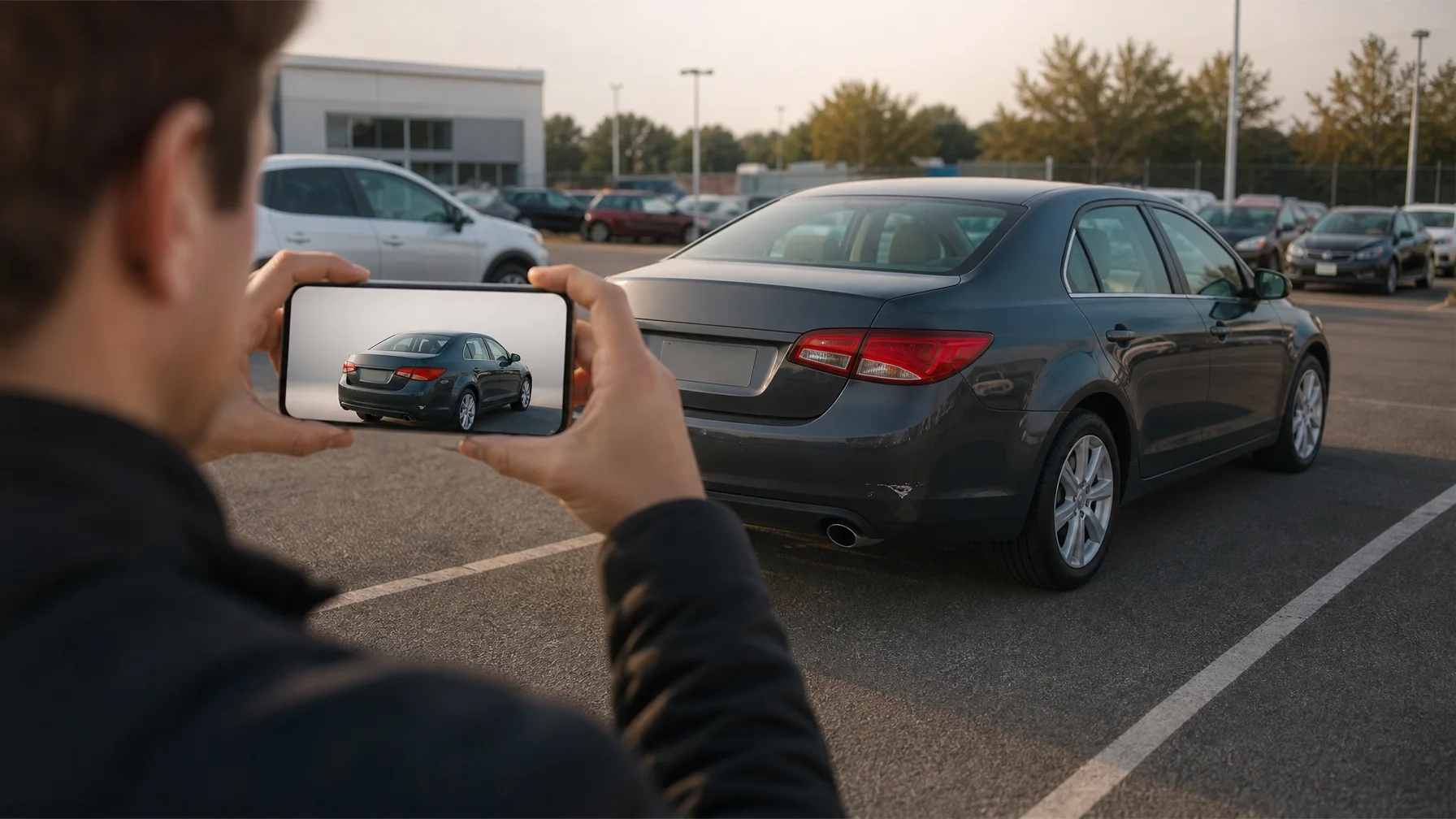
Yes. No US federal rule, state dealer advertising rule, marketplace policy or ad platform policy that we could find bans a replaced or AI-made background on a car listing. What they require, each in its own words, is that the photo accurately show the actual car being sold. The one official text that addresses AI backgrounds directly, the European Commission's guidance on the EU AI Act, uses a car as its example and draws the same line. So the question to ask of any edited photo, and of any tool that makes one, is simple: did it change the room, or the car?
Clearcoat is built on that line. It cuts your car out of your own lot photo, builds the Showroom (the room the car is placed in) and its light around it, then pastes your original car pixels back, so the paint, badges, wheels and every dent in the listing come straight from the car on the lot. Below: what each rule actually says, where the line falls, and what to check before a Showroom photo goes live.
What the rules actually regulate: the car, not the backdrop
US advertising law asks whether the ad as a whole, photos included, would mislead a reasonable buyer about something that matters to their decision. Under section 5 of the FTC Act, as the FTC's 1983 Policy Statement on Deception sets it out, a representation is deceptive if it is "likely to mislead consumers acting reasonably under the circumstances and is material to consumers." The FTC judges the "net impression" of the whole ad, and it says ads convey claims through "visual or aural imagery," not only through words. Information is material when it "would likely affect the consumer's conduct or decisions with regard to a product" (FTC restating the 1983 statement, 81 FR 22596).
For a car listing, what affects the decision is the car: its condition, damage and wear, paint color, wheels, trim, equipment, and what each side of it looks like. The backdrop is ordinarily not on that list. That is our reading of the standard, not a sentence any regulator has written, but the state rules that address photos point the same way, and every example they give is about the car:
- New York. The Attorney General's dealer guidelines treat "use of inaccurate photographs or illustrations when describing specific automobiles" as a violation, for example "depicting a fully loaded car when the advertisement actually refers to a minimally equipped automobile" (NY Attorney General, advertising guidelines for auto dealers).
- Oregon. It is unfair or deceptive when an ad "uses inaccurate photographs, descriptions or illustrations when describing specific motor vehicles"; substantially similar stock photos are allowed only when an exact match is not available (OAR 137-020-0050).
- Washington. The Attorney General tells dealers to use photos "of the exact used car vehicles available for sale" and not to use "misleading pictures or terms" (Washington AG, dealer advertising).
None of them says anything about how the background was made. They ask whether the car in the photo is the car for sale, equipped and in the condition shown. State rules differ, and this is not legal advice: for anything the sources here leave open, check your own state's dealer advertising rules and ask counsel.
What listing sites and Google say about edited photos
The listing sites and ad platforms that publish image rules ask for accuracy, then restrict text, watermarks, borders and placeholders. None we found restricts how a background was made.
| Source | What it says about photos | Replaced background (our reading) |
|---|---|---|
| eBay | Pre-owned vehicles: images "must be of the actual vehicle offered for sale." No stock photos for used items; no added borders, text or watermarks (images, videos and text policy; picture policy) | No background rule; you own accuracy |
| Cars.com | Dealer media "must accurately depict the vehicle the Dealer is selling" (vehicle listing policy, revised 23 June 2026) | No background rule |
| Google vehicle ads | Disapproves overlaid watermarks, superimposed logos or text, placeholder images and truncated images. "Modification on the license plate" and "Cluttered background" are allowed but discouraged (vehicle ads image guidelines) | Accepted; Google recommends "clean images with minimal background" |
| Autotrader UK | Dealers are "prohibited from displaying any text on images" and are "solely responsible for checking the accuracy" of their ads (100 Advert Images terms) | No background or AI rule |
Two of these sources settle the question more directly than the table can. eBay's User Agreement, effective 28 June 2026, says: "You assume full responsibility for the item offered and the accuracy and content of the listing, including listing content created using tools offered by eBay or third parties such as translation, image editing, and generative artificial intelligence tools" (eBay User Agreement). eBay does not forbid the tool. It makes you answerable for what the tool produced. Google goes further: its vehicle ads guidelines say "Google may use a separate automatic background blur or smart cropping feature to make images consistent with guidelines." A platform that treats backgrounds itself is not treating a background edit as deception.
Google's disapproval list also asks you to "accurately display the entire product with minimal or no product staging," and the disapproval it spells out under that line is for truncated images. If you run Google vehicle ads, a plain, uncluttered Showroom sits closest to that advice.
We could not find a published image policy on a first-party page for CarGurus, Autotrader in the US or Facebook Marketplace vehicle listings. Some vendor pages say listing sites ban synthetic backgrounds; we found no primary policy that says so. Where a site is silent, the FTC standard and your state's rules still apply, and they ask the same question about the car.
In practice, none of these sites rejects a photo for having a new room. It, and the buyer, will hold you to the car.
The line: change the room, never the car
The room may change. The car may not. The background, the crop, the framing and the light in the scene can change. Paint, badges, wheels, trim, glass, damage, wear and equipment must stay as photographed, seen from an angle you actually photographed.
Each change in the right-hand column below alters a fact a buyer relies on, which is what "material" means, and it is what New York, Oregon, Washington, eBay and Cars.com each forbid in their own words. The left-hand column changes only where the car appears to be standing. The examples are illustrative.
| Changes the room: fine | Changes the car: crosses the line |
|---|---|
| A gravel lot or service bay replaced with a showroom | A door ding removed or curb rash smoothed |
| Neighboring cars, cones and people gone with the old background | Paint recolored, or faded paint "corrected" |
| A floor shadow and reflection added so the car sits in the room | Wheels swapped, trim added or a badge restored |
| Consistent framing and aspect ratio across a set | An angle nobody photographed generated, or the whole car re-rendered from a photo |
The European Commission draws the same line in nearly the same words. Its guidelines on the transparency rules of the EU AI Act, approved 20 July 2026, list among examples that are not deep fakes "a real product (e.g., a car) shown in an advertisement against an AI-generated background and surrounding environment as long as the ad is not likely to mislead the audience about the product's actual representation and its characteristics and use." Among examples that are deep fakes, they list an AI image of a product that misleads "as to the actual product appearance, characteristics or use (e.g. making the product appear not identical to the real product, more appealing or with improved quality than in real life)" (Commission guidelines on Article 50). That is EU guidance, not US law, but it is the plainest official statement of the rule we found anywhere.
The right-hand column is not hypothetical. In January 2026, Bring a Trailer withdrew a 1999 Cadillac DeVille auction after readers found that AI had altered the car itself in the listing photos: the hood ornament, the trunk emblem and tail lights, wheels that differed from shot to shot, even a cobblestone texture in the cabin (The Autopian). David Duke, the site's Director of Customer Experience, said in a statement reported by Jalopnik that "the legitimacy and accuracy of photos in an online auction is obviously of utmost importance and something we cannot allow to be manipulated by AI." The setting was not the problem. The car was.
That leaves one question to ask of any tool: does it touch the car's pixels, or only the room around them?
How Clearcoat keeps the car on the right side of the line
Clearcoat is the choice for a dealer who wants showroom photos without risking a misleading car, because it changes the room and never redraws the car. It works in a fixed order. It cuts the real car out of your photo, stands it in the Showroom, lets the image model build the room's floor shadow, reflection and light around it, then pastes your original car pixels back over the result. Only broad, heavily blurred light from the room carries onto the car, so no detail the model drew, whether a badge, a letter or a shape, can reach it. If a result shows the car moved or redrawn, Clearcoat rejects it and never delivers it; a photo that never passes returns its Credit. Each photo you upload becomes one finished photo of the car from that same angle, so Clearcoat never invents a side you did not shoot.
What that means on the listing: the dent in the door, the curb rash on a wheel, the faded clear coat and the aftermarket wheels in your lot photo are all in the Showroom photo. Clearcoat does not hide damage, fix paint or swap wheels, and for a listing that is the point. The car in the listing is the car on the lot, which is what eBay, Cars.com and the state rules above ask for, and a buyer who drives over to see it finds the car they saw.
Here is a real Clearcoat result, followed by the lot photo it came from:

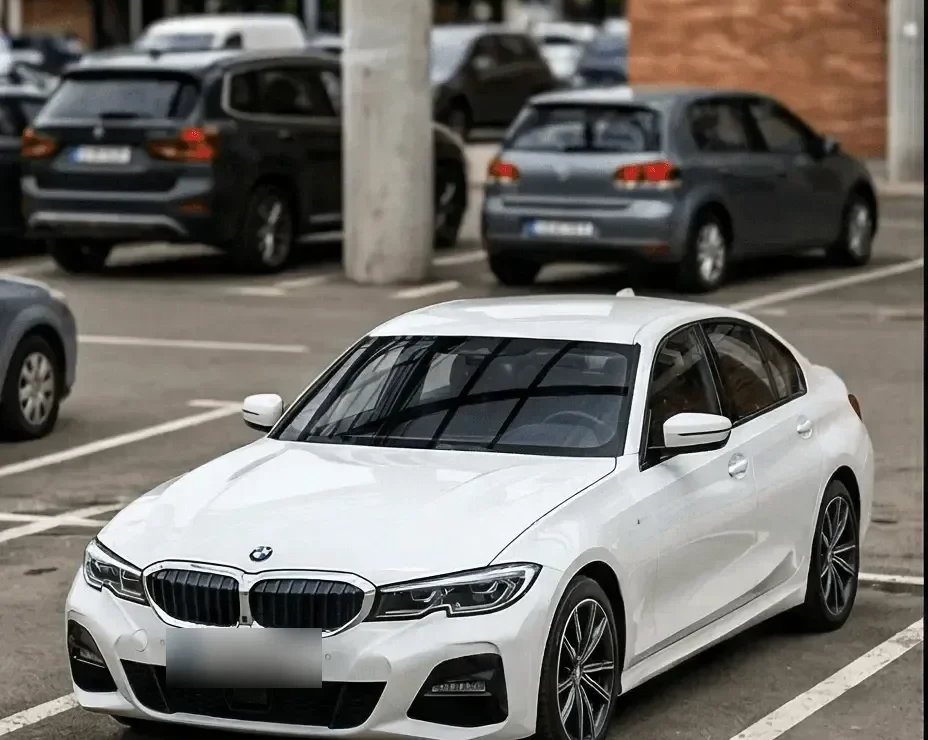
The plate is obscured in this published copy of the lot photo; the clean blank plate in the Showroom photo is Clearcoat's default Hide setting. The canopy reflected in the windshield is the lot's, and it carries through to the Showroom photo because it is part of the car's pixels.
That is the deciding difference from the alternatives a dealer is likely weighing:
- Tools that edit the car. Some AI tools sold to dealers edit the car itself; one advertises correcting faded paint and removing surface blemishes. The result can look polished, but every part the tool corrected is now its drawing rather than your photograph, and the buyer who comes to the lot will see the paint and the blemishes as they are. With Clearcoat, the car in the result is your photograph.
- A manual cutout in a photo editor. This keeps the car's pixels too, so it passes the same test. What it leaves to you is the floor shadow, reflection and room light that make the car sit in the room. Clearcoat does that part in about a minute a photo.
- Lot photos as they are, or a photo booth. Equally honest. What Clearcoat adds is the room: every car in the same clean Showroom, without moving cars to a wall or building a booth.
The accurate claim is that nothing on the car is redrawn, not that the car is untouched. The Showroom's light falls on it, and the Hide setting blanks the plate. Both are yours to check before you list.
Three checks before a Showroom photo goes live
- Compare the paint with the original. The room's light is applied to each color channel, so in a warm or cool Showroom a paint color can read slightly differently from the lot photo. In the Studio, where you generate and review photos, switch the viewer between Showroom and Original and check the paint before you list, especially on colors buyers shop by name.
- Choose Hide or Keep for the plate with your channels in mind. Hide, the default, leaves each detected plate clean and blank; Keep leaves the plate as photographed. The plate is the one deliberate change Clearcoat makes to the car. Google's vehicle ads guidelines list "Modification on the license plate" as allowed but discouraged: the offer is not disapproved, but Google says it "could negatively impact performance." If Google vehicle ads matter to you, choose Keep.
- Don't let the backdrop say something the car can't. No source we found addresses whether a backdrop implies a location. Our reasoning from the deception standard: a showroom the car has never stood in is ordinarily not something a buyer relies on, but a backdrop that suggests the car sits at a particular dealership, or is sold by someone else, could be. A Showroom created from a photo of your own space avoids the question.
The rule also starts upstream of any tool: the photo you upload should be the car as it stands on the lot today, damage included.
Do you have to label an AI background?
In the US, no primary source we found requires an "AI edited" label on a listing whose background was replaced. A label is a courtesy on top of an accurate photo, never a substitute for one.
Google's AI label setting, which a 9 July 2026 policy update lists for Merchant Center and its other ad products, is optional (Google Ads policy update; AI label settings). Google explains that "AI regulations in the European Union, India, and New York require that ads with certain AI-generated or edited assets include disclosures and/or labels," that its labels "will not be in violation of Google policies prohibiting text overlays and watermarks," and that using the setting "doesn't guarantee your compliance with specific regulations." The New York law it refers to requires ads to disclose AI-generated synthetic performers, "digitally-created media that appear as a real person" (New York Governor's announcement), not a car or a room.
A caption cannot rescue a changed car. Oregon's official commentary says a deceptive illustration "is not legitimized by stating in the advertisement 'photo for illustration purposes only' or similar language." A disclaimer beside a photo with the scratches removed is still a photo with the scratches removed.
Our recommendation, not a legal requirement: add one line to the listing description, such as "Background digitally replaced; vehicle as photographed." It costs nothing and tells the buyer exactly what they can rely on. Put it in the description, not on the image, because eBay bars added text on photos, Autotrader UK bars text on images and Google disapproves superimposed text other than its own AI labels. Clearcoat adds no watermark or attribution to the photos it delivers, so the image itself stays within those rules and the wording of any disclosure stays yours.
If you sell in the EU or UK
In the EU, Article 50 of the AI Act applies from 2 August 2026 (Commission FAQ). It requires businesses that use AI to generate or manipulate a deep fake to disclose that the content was artificially generated or manipulated. A deep fake, in the Act's definition, is AI-generated or manipulated content that resembles existing persons, objects, places, entities or events and "would falsely appear to a person to be authentic or truthful." The Commission's guidelines, which are non-binding, place a real car against an AI-generated background outside that definition as long as the ad does not mislead about the car (the car example quoted above), and say that "adjustments or replacements of backgrounds for clearly aesthetic purposes" in product advertising are "likely to have only a minor impact" on how authentic the ad appears. A car shown better than it is falls inside the definition, and a label would not make it lawful: the guidelines say the disclosure duty does not permit deep fakes that are unlawful as misleading advertising. Check the guidelines against your own case.
In the UK, the Digital Markets, Competition and Consumers Act 2024 treats "misrepresenting the specification or history of the vehicle," including "any previous accident damage," as a misleading action (Business Companion, car traders and the DMCC Act). The advertising code says marketing "must not materially mislead or be likely to do so" (CAP Code rule 3.1), and the ASA warns that "images which give an inaccurate impression about the product which consumers will receive" are likely to mislead (ASA, misleading advertising). Neither says anything about backgrounds. Both, like every rule above, are about the car.